The Mansion-Tax Repeal Just Vanished From the November Ballot. What Replaced It Matters More.
For most of the past year, the story out of Sacramento was that California voters would finally get to weigh in on Measure ULA — Los Angeles's "mansion tax" — this November, by way of a statewide initiative that would have wiped it out. Plenty of coverage still says so. A widely circulated law-firm alert dated July 2 still lists the repeal as "looming for November."
It isn't looming. On June 25, the Secretary of State confirmed the proponents had formally withdrawn the initiative before it ever qualified for the ballot. If you underwrite deals in Los Angeles, the measure you'll actually see in November is a different — and much quieter — document than the one the headlines promised.
The repeal that got traded away
The withdrawn measure was the Howard Jarvis Taxpayers Association's Local Taxpayer Protection Act, and it reached well past ULA. It would have required a two-thirds vote for any citizen-initiated local special tax, barred charter cities from levying real estate transfer taxes at all, and invalidated charter-city transfer taxes already on the books. ULA — a transfer tax, in a charter city, passed below two-thirds — was the marquee casualty, but it would have taken a pile of other local revenue tools down with it.
Governor Newsom and legislative leaders cut a deal instead. In exchange for the withdrawal, the Legislature agreed to put its own, far narrower constitutional amendment on the ballot and to pull a "poison pill" (ACA 13) that had been aimed at the Jarvis measure. The sweeping repeal is gone, and so is the direct threat to the roughly $1 billion ULA has collected since 2023.
Proposition 43, in plain terms
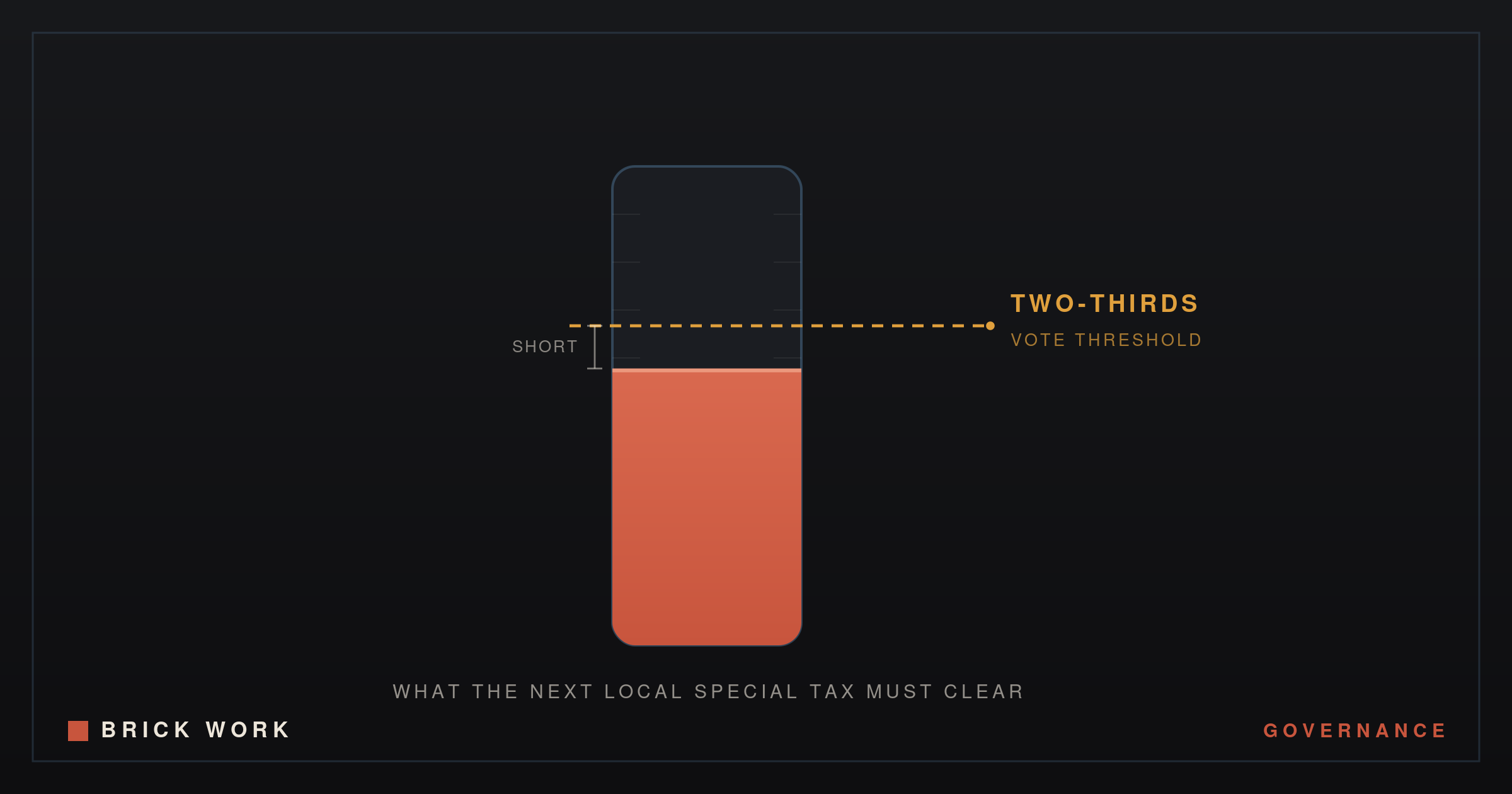
The replacement is Proposition 43 — the legislative amendment ACA 22. Per the Legislative Analyst, beginning January 1, 2027 it would require any new, increased, or extended local special tax proposed by voters to pass by two-thirds. That closes a path recent court rulings had opened, under which voter-sponsored special taxes could clear with a simple majority.
Read it carefully: Prop 43 is forward-looking. It does not repeal ULA, touch its rate, or claw back a dollar it has raised. What it changes is the difficulty of the next one.
> Measure ULA passed in 2022 with about 58% of the vote. Under Proposition 43, a special tax like it would need two-thirds — and 58% doesn't clear that bar.
What it means for land basis
For today's underwriting, nothing moves. ULA still lands at 4% on sales from $5.4 million to $10.9 million and 5.5% above that — the thresholds now index up with inflation — stacked on top of the city's 0.45% and the county's 0.11% transfer taxes. And the drag is real: the UCLA Lewis Center's April 2025 analysis found the odds of a property trading above the threshold fell by as much as 50% after ULA took effect, with non-single-family sales — commercial, industrial, multifamily — down 30 to 50%. That friction is already priced into land basis, and Prop 43 doesn't lift it.
What Prop 43 changes is the political cost of the next tax. A future ULA-style earmark gets much harder to pass — welcome news if your read is that transfer-tax drag is throttling the exact commercial and multifamily turnover the region needs. But the same two-thirds bar falls on a local housing bond, an infrastructure levy, or a transit measure a project might actually want. The mechanism doesn't care which direction the money flows.
So the fight didn't end this November — it moved. The question stopped being "will they repeal the tax" and became "how hard is it to pass the next one," and California just answered: harder. If you're pricing land here, the cost you can see today is stable; the cost of whatever voters approve next now carries a two-thirds price of admission. Watch the November result, then watch which cities test the new threshold first.
This is a read on a pending ballot measure and existing law, not legal advice — ballot language can still change and transfer-tax treatment is transaction-specific, so confirm the current rules before you rely on them.
Sources
California Legislative Analyst's Office — Proposition 43 analysis, "Limits Voters' Ability to Raise Revenues for Local Government Services. Legislative Constitutional Amendment." (Nov. 3, 2026 ballot): https://lao.ca.gov/ballot/2026/prop43-110326.pdf
Our Weekly — Ballot set for California November election after deal removes local-tax measure (Jul 9, 2026), detailing the June 25 withdrawal, the Newsom/legislative compromise, ACA 22, and the pulled ACA 13: https://www.ourweekly.com/2026/07/09/ballot-set-for-california-november-election/
Ballotpedia — California Two-Thirds Vote Requirement for Special Taxes and Charter City Real Estate Transfer Tax Prohibition Initiative (2026), status "Not on the ballot": https://ballotpedia.org/California%5FTwo-Thirds%5FVote%5FRequirement%5Ffor%5FSpecial%5FTaxes%5Fand%5FCharter%5FCity%5FReal%5FEstate%5FTransfer%5FTax%5FProhibition%5FInitiative%5F(2026)
UCLA Lewis Center for Regional Policy Studies — Manville & Smith, "The Unintended Consequences of Measure ULA" (April 2025): https://www.lewis.ucla.edu/research/the-unintended-consequences-of-measure-ula/
Hanson Bridgett LLP — "The ULA Ordinance and Recent Updates: Increased Thresholds and LA City Council Proposes New Exemptions" (Jul 2, 2026), current 2026 rates/thresholds and revenue: https://www.hansonbridgett.com/publication/260701%5F7087%5Fula%5Fordinance%5Fupdate%5Fjune
UCLA Lewis Center — Ling et al., "An Analysis of Measure ULA" (Sept. 2022), original $923-million annual revenue projection: https://lewis.ucla.edu/research/an-analysis-of-measure-ula-a-ballot-measure-to-reform-real-estate-transfer-taxes-in-the-city-of-los-angeles/