LA Just Hit Every Pause Button on Its Biggest Housing Law
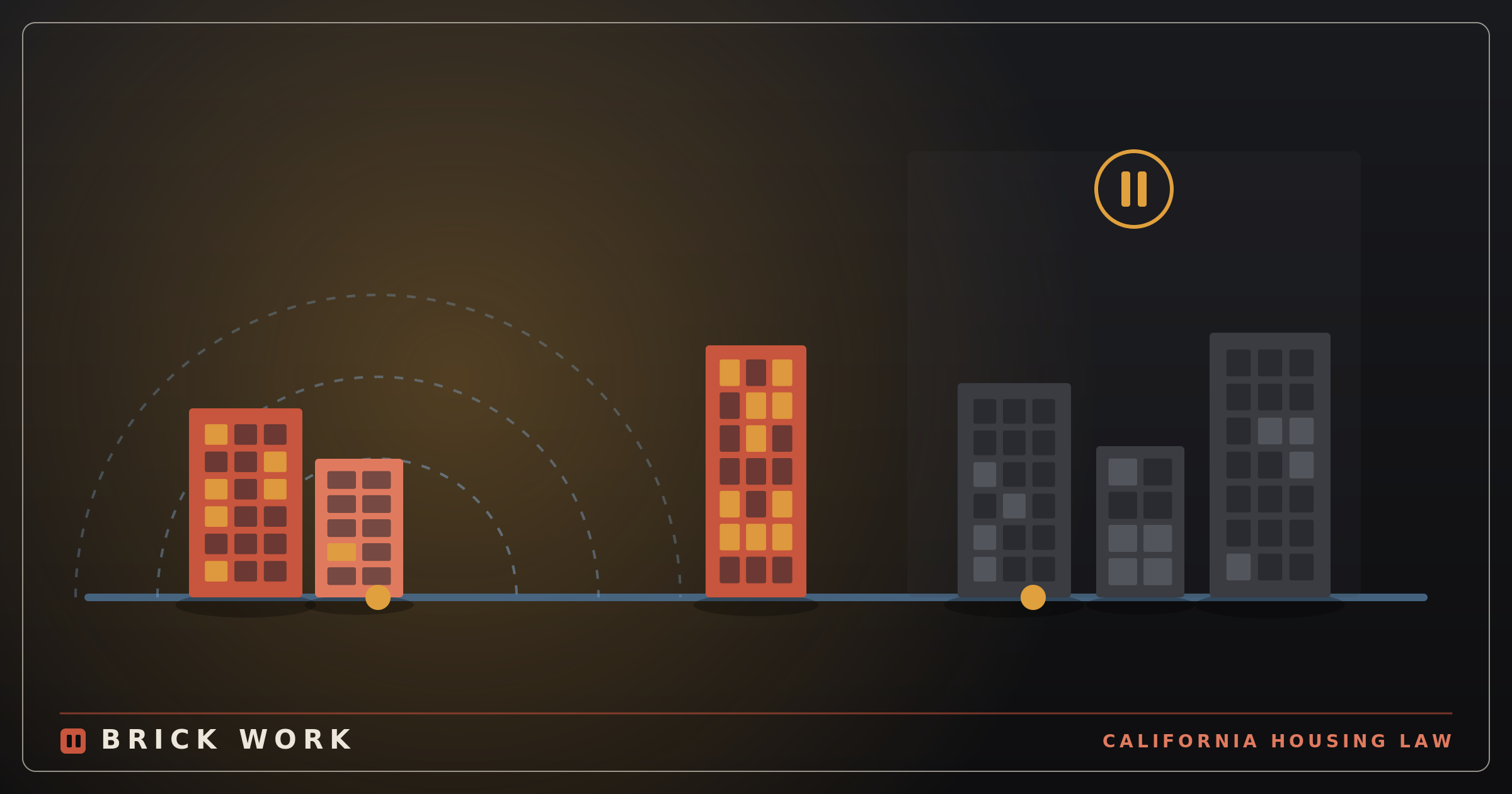
California spent 2025 passing SB 79, Scott Wiener's transit-density law (signed October 10). The pitch was refreshingly blunt: if you own land within a half-mile of a real train or bus-rapid-transit stop, you can build multifamily — up to roughly nine stories at the biggest stations — regardless of what local zoning says. Statewide effective date: July 1, 2026.
LA's response was to adopt its own ordinance on June 30, 2026 — one day early. In housing, as in comedy, timing is everything.
The maneuver (clever, and a little cheeky)
SB 79 has a temporary-exclusion clause. A city can defer full implementation if it can show its zoning already allows at least 50% of the housing capacity SB 79 would create. So LA preemptively upzoned dozens of higher-income single-family neighborhoods to allow 3–4-story multiplexes — pushing itself over that 50% line — and then used the headroom to exclude lower-income "low-resource" areas, very-high fire-hazard zones, and historic districts from the automatic upzoning. The deferral runs to 2030, a year past the region's next Housing Element cycle.
Read that twice. To slow down an upzoning law, LA upzoned itself first.
> The number that matters: a half-mile. That's the SB 79 radius — and in LA, whether your parcel sits inside or outside just got a lot more interesting.
Why an operator should actually care
First, the map that matters isn't the state law — it's LA's ordinance, plus the companion Low-Rise Ordinance the city adopted the same week, which quietly legalized small-scale multifamily in low-density zones near designated "Opportunity Stations." If you're hunting sites right now, some of the cleaner upside is in the neighborhoods LA chose to upzone to hit its 50% — not only the transit-rich corridors everyone assumed SB 79 would unlock.
Second — and nobody has priced this in — the state hasn't blessed the move. HCD still has to sign off on local ordinances, and it has not ruled on whether "upzone to 50%, then exclude" is legal. It already rejected Beverly Hills' alternative transit plan in May and approved San Jose's industrial-hub carve-out in June, so it's clearly reviewing these one city at a time. Translation: LA's 2030 pause is real today and potentially reversible tomorrow. If you're underwriting a deal on the assumption the pause holds, put a contingency on it.
The honest read
This isn't villainy and it isn't a win — it's a big, complicated city buying itself four years. Whether that reads as prudent phasing or polite obstruction depends mostly on which neighborhood you're standing in. What's not up for debate: the LA entitlement path now runs through a local ordinance that changed on June 30, and a state agency that hasn't yet said "fine."
So next time someone tells you SB 79 "legalized density near transit," you can nod — then ask them which version of the LA map they're using. That question alone will tell you who's actually read it.
Sources
- California YIMBY — SB 79 summary: https://cayimby.org/legislation/sb-79/
- CalMatters — SB 79 implementation: https://calmatters.org/housing/2026/04/sb-79-implementation/
- LA City Planning — SB 79 resources: https://planning.lacity.gov/resources/senate-bill-sb-79
- Holland & Knight — Tracking SB 79 Implementation: https://www.hklaw.com/en/insights/publications/2026/06/tracking-sb-79-implementation