The Ultimate Guide to Creating a Real Estate Development Pro Forma
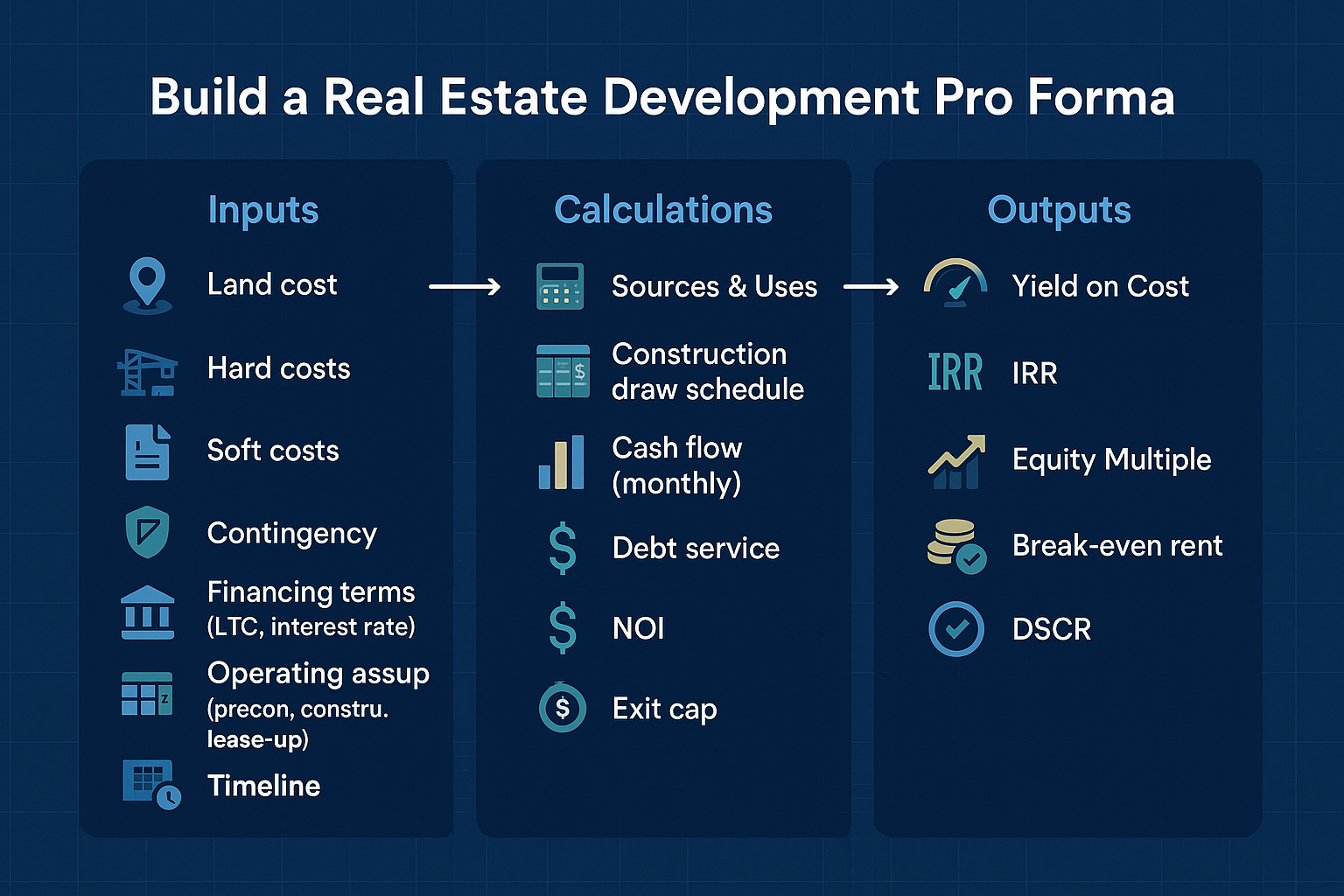
What is a Real Estate Development Pro Forma? A real estate development pro forma is a financial model that projects the costs, revenues, and returns of a development project from acquisition through stabilization. It serves as the foundation for investment decisions, lender underwriting, and investor presentations.
Think of it as your project's financial blueprint—showing whether a deal pencils out before you commit capital.
Why Pro Formas Matter in Today's Market With construction costs up 30%+ since 2020 and interest rates at multi-decade highs, accurate financial modeling has never been more critical. A well-built pro forma helps you:
Secure financing from construction and permanent lenders Attract equity partners with clear return projections Navigate entitlements by demonstrating project feasibility Manage risk through sensitivity analysis Make go/no-go decisions with confidence Core Components of a Development Pro Forma 1. Development Costs (Uses of Funds) Land Acquisition
Purchase price Closing costs (title, escrow, legal) Due diligence expenses Hard Costs
Site preparation and demolition Building construction ($/SF varies by asset class) Tenant improvements Landscaping and hardscaping Utilities and infrastructure Soft Costs
Architecture and engineering (8-12% of hard costs) Permits and fees Legal and professional services Construction loan interest Developer fee (typically 3-6%) Marketing and leasing Contingency (5-10% of total project cost) 2. Development Timeline Create a realistic construction schedule showing:
Pre-development phase (6-18 months) Construction period (12-36 months depending on asset type) Lease-up/absorption period (6-24 months) Stabilization timeline 3. Revenue Projections (Sources of Funds) Rental Income
Market rent analysis by unit type/square footage Absorption schedule and lease-up assumptions Escalation rates (typically 2-4% annually) Vacancy assumptions (5-10% at stabilization) Other Income
Parking revenue Storage fees Laundry income Pet fees and deposits 4. Operating Expenses Property management (3-5% of gross income) Maintenance and repairs Utilities Insurance Property taxes Marketing and leasing costs 5. Financing Structure Construction Loan
Loan-to-cost ratio (typically 70-80%) Interest rate (Prime + 1-3%) Loan term and extension options Interest reserve calculations Permanent Financing
Loan-to-value ratio (75-80%) Interest rate and amortization Debt service coverage ratio requirements (1.20x minimum) Equity Requirements
Developer equity contribution Limited partner equity Preferred return structures Profit sharing waterfalls Step-by-Step Pro Forma Creation Process Step 1: Market Analysis and Unit Mix Optimization Research comparable properties to establish:
Achievable rents by unit type Absorption rates for similar projects Operating expense ratios Cap rates for stabilized assets Step 2: Cost Estimation Hard Cost Benchmarking
Multifamily: $200-400/SF (varies by market and finish level) Office: $300-500/SF Retail: $150-300/SF Industrial: $100-200/SF Soft Cost Allocation
Typically 25-35% of hard costs Higher percentages for complex entitlements or challenging sites Step 3: Cash Flow Modeling Build monthly cash flows showing:
Development period negative cash flows Lease-up phase improving performance Stabilized operations Exit scenarios (sale or refinance) Step 4: Return Calculations Key Metrics to Calculate:
Internal Rate of Return (IRR): Target 15-25% for development Multiple on Invested Capital (MOIC): Typically 1.5-2.5x Net Present Value (NPV): Should be positive at required return rate Development Yield: Stabilized NOI ÷ Total Development Cost Step 5: Sensitivity Analysis Test key variables:
Construction cost overruns (+10%, +20%) Rent achievement (90%, 95% of projections) Interest rate changes (+100, +200 basis points) Timeline delays (+6, +12 months) California-Specific Considerations Density Bonus Programs State Density Bonus Law: Up to 35% density increase for affordable housing AB 2011: Streamlined approvals for affordable projects SB 9: Duplex and lot split opportunities Impact Fees and Exactions Development impact fees can range $20,000-100,000+ per unit Affordable housing in-lieu fees Utility connection charges Prevailing Wage Requirements Projects with public funding typically require prevailing wage Can increase labor costs 20-40% Common Pro Forma Mistakes to Avoid Underestimating soft costs - Often the biggest budget buster Overly aggressive absorption - Market conditions change Insufficient contingency - 5% minimum, 10%+ for complex projects Ignoring carry costs - Interest and taxes during extended timelines Static rent assumptions - Model realistic escalations and concessions Technology Tools for Pro Forma Development Spreadsheet-Based:
Microsoft Excel with custom templates Google Sheets for collaboration Specialized Software:
Argus Developer RealData Pro Forma REFM (Real Estate Financial Modeling) Emerging AI Tools:
Automated market rent analysis Construction cost databases Sensitivity modeling platforms When to Hire Professional Help Consider engaging consultants when:
Dealing with complex mixed-use projects Navigating unfamiliar markets Seeking institutional capital Managing multiple financing sources Requiring third-party validation for lenders Our consulting services include:
Custom pro forma development Market analysis and rent studies Financing strategy optimization Investor presentation preparation Ongoing project monitoring and updates Conclusion A well-constructed pro forma is your roadmap to development success. It transforms complex projects into understandable financial models that guide decision-making and attract capital.
Remember: garbage in, garbage out. Invest time in accurate market research, realistic cost estimates, and conservative assumptions. The extra effort upfront can save millions in avoided mistakes.
Ready to build your next pro forma? Our team of real estate finance experts can help you create institutional-quality financial models that get deals funded. Contact us today to discuss your project's specific needs.
This guide provides general information and should not be considered financial or investment advice. Always consult with qualified professionals before making investment decisions.